
After 35 years in the classroom, I have tried just about every extension activity you can imagine. Some were complicated to set up. Some required hours of preparation. Some worked brilliantly for my high potential learners but left everyone else behind — or the other way around.
The $100 Word Challenge is none of those things.
It is one of the simplest activities I have ever used, it requires zero preparation, and it is genuinely one of the most effective tasks I have ever put in front of a mixed-ability primary class. Every single student can access it. Nobody runs out of challenge. And in over three decades of teaching, I have never once had a student tell me it was boring.
That, in my experience, is extremely rare.
How It Works
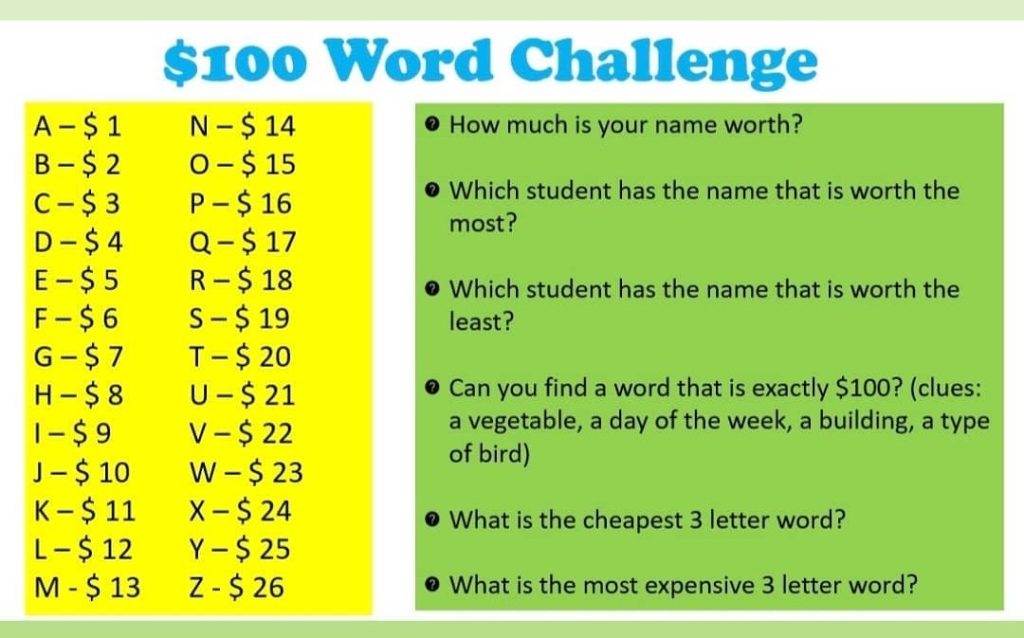
The concept is beautifully simple. Each letter of the alphabet is assigned a dollar value — A is worth $1, B is worth $2, C is worth $3, and so on all the way to Z, which is worth $26.
Students then use these values to calculate the worth of words — adding up the value of each letter to find a total. Make sure you get them to show their working out – this is great for seeing how they go about adding multiple numbers. You could also allow them to check with a calculator.
That’s it. That’s the whole activity.
What makes it extraordinary is what happens next.
What Every Student Does
Every child in your class can begin immediately. There is no complicated explanation, no confusing set of rules, no student sitting there not knowing where to start.
Younger or less confident students begin by working out how much their own name is worth. This is personal, it is engaging, and it involves meaningful addition practice that doesn’t feel like a worksheet. Then they start comparing — whose name is worth the most in the class? The least? What about their teacher’s name?
From there, they explore simple words. What is the cheapest three-letter word? What is the most expensive? Can they find a word worth exactly $50?
Every one of these questions is self-directing. Students generate their own next challenge without needing to come back to you.
What Your HPGE Students Do
This is where the magic happens.
The ultimate challenge — can you find a word worth exactly $100? — sounds straightforward. It is anything but. Students quickly discover that getting to exactly $100 requires real strategic thinking. They can’t just guess randomly. They start to develop systems, test hypotheses, eliminate possibilities, and refine their approach.
And then, when they find one word worth $100, they want to find another. And another. They start asking their own questions — is there a pattern? Are there more words worth $100 that belong to the same category? What is the most expensive word they can possibly find?
One of my classes found over 120 synonyms for the word “said” during a related vocabulary challenge. They did not want to stop. That is the kind of intrinsic motivation that high potential learners thrive on — and that no worksheet has ever produced in my classroom.
Why This Works So Well
The $100 Word Challenge works because it has what educators call a low floor and a high ceiling. Every student can get started — that’s the low floor. But there is no point at which a student reaches the top and has nothing left to do — that’s the high ceiling.
This is the holy grail of differentiation. One task, genuinely accessible to every learner in your room, with no artificial cap on how far the thinking can go.
It also works because students are in control of their own challenge level. Nobody is being pulled out of the room. Nobody is being given a different, more complicated task that signals to the class that they are in a different group. Everyone is doing the same activity — just taking it in completely different directions based on their own curiosity and ability.
In a busy primary classroom, that is incredibly valuable.
How to Use It
As a full lesson activity: Give the class the full set of challenge questions and let them work through at their own pace. Your high potential learners will still be going long after others have moved on.
As a warm-up: Five minutes at the start of a maths or English lesson. Give students the letter values and one starting question — how much is your name worth? — and watch them go.
As an early finisher activity: Keep the letter chart on display and let students return to it whenever they have finished other work. It is endlessly generative — students will keep finding new challenges for themselves.
As a home activity: Send it home with parents. It requires nothing but a pencil and the letter chart, and it works just as well at the kitchen table as it does in the classroom.
The Challenge Questions
To get you started, here are the questions I use with my classes:
- How much is your name worth?
- Which student in your class has the most expensive name? The least expensive?
- What is the cheapest three-letter word you can find?
- What is the most expensive three-letter word?
- Can you find a word worth exactly $50? Exactly $75? Exactly $100?
- Can you find a word worth exactly $100 that is a vegetable? A day of the week? A type of building? A bird?
- What is the most expensive word you can possibly find?
- Make up your own $100 Word Challenge question for a friend.
That last one is particularly powerful for high potential learners. The moment a student starts generating their own questions, they have moved from being a consumer of the task to being a creator — and that is where the deepest thinking happens.
A Note on Vocabulary
This activity crosses beautifully into English as well as mathematics. Once students are familiar with the letter values, you can connect it to vocabulary work — can you find a word worth exactly $100 that means “happy”? That describes weather? That you might find in a science textbook?
Suddenly you have a task that builds mathematical fluency, vocabulary knowledge, strategic thinking, and creative reasoning — all at once, with no extra preparation on your part.
Try It Tomorrow
If you are looking for one activity to try with your class this week — particularly if you have high potential learners who are ready for something more — this is it.
Put the accompanying visual up on the board and get out of the way. You might be surprised how long the room stays quiet.
How much is your name worth? Mine is Caroline and I’m worth $77 — I’ll let you work your name out. 😊


