
By Caroline, Depth Education
There are so many thinking frameworks out there that it can be hard to know where to start. Bloom’s Taxonomy, the Six Thinking Hats, Thinker’s Keys, Multiple Intelligences… they all sound useful, but which one is right for the lesson in front of you?
After more than 35 years of teaching, my answer is that it depends on what you want students to do. This quick guide matches each framework to a purpose, with a classroom example for each, so you can pick one and try it this week.
The Quick Guide
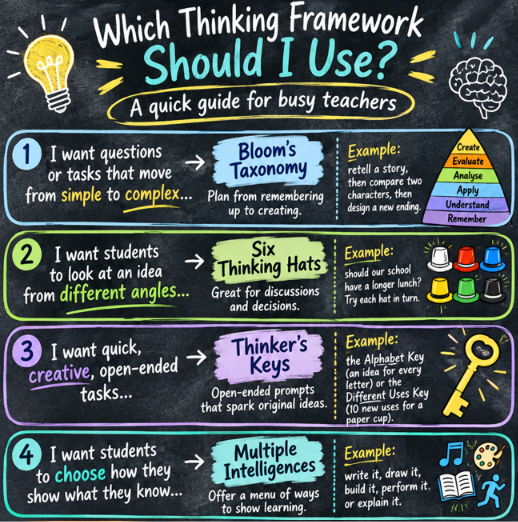
- I want questions or tasks that move from simple to complex → Bloom’s Taxonomy
- I want students to look at an idea from different angles → The Six Thinking Hats
- I want quick, creative, open-ended tasks → Thinker’s Keys
- I want students to choose how they show what they know → Multiple Intelligences
- I want a balanced set of tasks across different kinds of thinking → The four Depth Education domains
Bloom’s Taxonomy
Best for: planning questions and tasks that build from simple to complex.
Bloom’s Taxonomy was developed by Benjamin Bloom and colleagues in 1956, and revised in 2001 by Lorin Anderson and David Krathwohl. The revised version has six levels: Remember, Understand, Apply, Analyse, Evaluate and Create.
In the classroom: Choose a topic and write one question or task for each level. For a story, students might retell the plot (Remember), explain a character’s feelings (Understand), compare two characters (Analyse), judge which character made the best choice (Evaluate) and design a new ending (Create).
A tip for gifted students: A higher level doesn’t mean more work. One good Evaluate or Create task is worth more than ten extra Remember questions.
The Six Thinking Hats
Best for: discussions, decisions and looking at an idea from several sides.
The Six Thinking Hats was created by Edward de Bono. Each coloured hat is a different way of thinking: white (facts), red (feelings), black (caution and problems), yellow (benefits), green (new ideas) and blue (managing the thinking).
In the classroom: Pose a question such as “Should our school have a longer lunch break?” and ask students to consider it through each hat in turn. It works well in small groups, because each student can wear a different hat.
Thinker’s Keys
Best for: quick, creative and open-ended challenges.
Thinker’s Keys were created by Tony Ryan, an Australian educator. There are 20 keys, each one a prompt that pushes students past the obvious answer.
In the classroom: The Alphabet Key asks students to come up with an idea or fact for each letter of the alphabet about a topic. The Different Uses Key asks students to think of ten new uses for an everyday object, such as a paper cup. These are great five-minute tasks, or the base for longer projects.
Multiple Intelligences
Best for: giving students choices in how they show their learning.
Multiple Intelligences is a theory from Howard Gardner, which describes eight kinds of intelligence, including verbal-linguistic, logical-mathematical, spatial, bodily-kinaesthetic, musical, interpersonal, intrapersonal and naturalist.
Researchers debate how well the theory holds up, and it’s easy for it to slide into labelling students (“he’s a visual learner”). I find it most useful as a menu of options, not as a way of sorting children.
In the classroom: After a unit, offer students a choice of ways to show what they’ve learned: write it, draw it, build it, perform it, explain it to a partner or create a song. Everyone gets the chance to use different strengths.
The Four Depth Education Domains
Best for: making sure a set of tasks covers different kinds of thinking.
This is the framework I use in my own resources. It has four domains:
- Deep Library – Investigate & Understand
- Idea Forge – Create & Transform
- Knowledge Garden – Connect & Grow
- Mind Observatory – Analyse & Evaluate
In the classroom: Build a choice board with one task from each domain, so students investigate, create, connect and evaluate across a unit.
Can I Use More Than One?
Yes, and they work well together. You might use Bloom’s to plan the levels of a unit, Thinker’s Keys to write quick prompts, and the Six Hats for a class discussion. The aim isn’t to use every framework, but to pick one that suits the job.
Not Sure Where to Start?
Pick one framework and try it for a week. A choice board based on Bloom’s, or a Six Hats discussion, is an easy first step, and you’ll quickly learn which suits your class.
Planning Templates and the Bundle
I’ve made planning template for each framework, so you can get started without building one from scratch. You can find them in the Depth Education Shop
If you’d like all four frameworks together, my Thinking Infographics Bundle includes an infographic, examples and planning sheets for Bloom’s Taxonomy, the Six Thinking Hats, Multiple Intelligences and Thinker’s Keys.
Which framework do you use most in your classroom? I’d love to hear in the comments. 💙
You’ll find more free resources for teachers at deptheducation.com.au.


